
How Much Does a House Extension Cost in St Albans?
St Albans is one of the most desirable places to live in the Home Counties — and with property prices consistently among the highest in Hertfordshire, extending rather than moving has become the preferred approach for a large proportion of local homeowners who want more space without leaving the area. The economics are compelling in a market where a four-bedroom property commands a premium over a three-bedroom that can rarely be replicated by the cost of an extension. But what does a house extension actually cost in St Albans — and what determines where within any given range your project will sit?
The honest answer is that house extension costs in St Albans span a wide range — wider than most homeowners expect when they start researching. The city’s housing stock covers a significant range of property types, plot sizes and planning contexts. The Victorian and Edwardian terraces of the city centre and the streets around the Abbey, the substantial inter-war and post-war detached and semi-detached properties of Marshalswick, Cunningham Hill and Jersey Farm, the affluent village settings of Sandridge, Wheathampstead and Redbourn, and the Green Belt boundary that runs close to several of St Albans’s most desirable residential streets all create a varied landscape for extension projects.
This post breaks down realistic current prices for the main extension types in the St Albans market and explains what most commonly drives the final cost up or down.
What Does a House Extension Cost in St Albans?
For a properly built, finished extension from a reputable St Albans builder, realistic current prices are:
Single storey rear extension:
- Up to 15 sqm: £38,000–£60,000
- 15–25 sqm: £55,000–£88,000
- 25–40 sqm: £82,000–£125,000+
Double storey extension:
- Standard two-storey addition: £80,000–£140,000+
Side return extension:
- Standard side infill: £45,000–£75,000
Wrap-around extension:
- Combined rear and side: £75,000–£130,000+
These are finished, installed prices covering structural work, roofing, external walls, glazing, internal plastering, floor finishes and basic decorating. Kitchen or bathroom fitting within the new space, bespoke joinery and premium glazing are priced separately.
St Albans sits at the upper end of the Hertfordshire construction market — and meaningfully above the national average. The city’s proximity to London, the strong local economy and the consistently high demand for skilled tradespeople across the area all contribute to labour costs that are higher than in most comparable towns further from the capital. For AL1, AL2 and AL3 postcodes and the surrounding area, the figures above represent realistic current pricing from an established local contractor.
The Main Extension Types
Single Storey Rear Extension
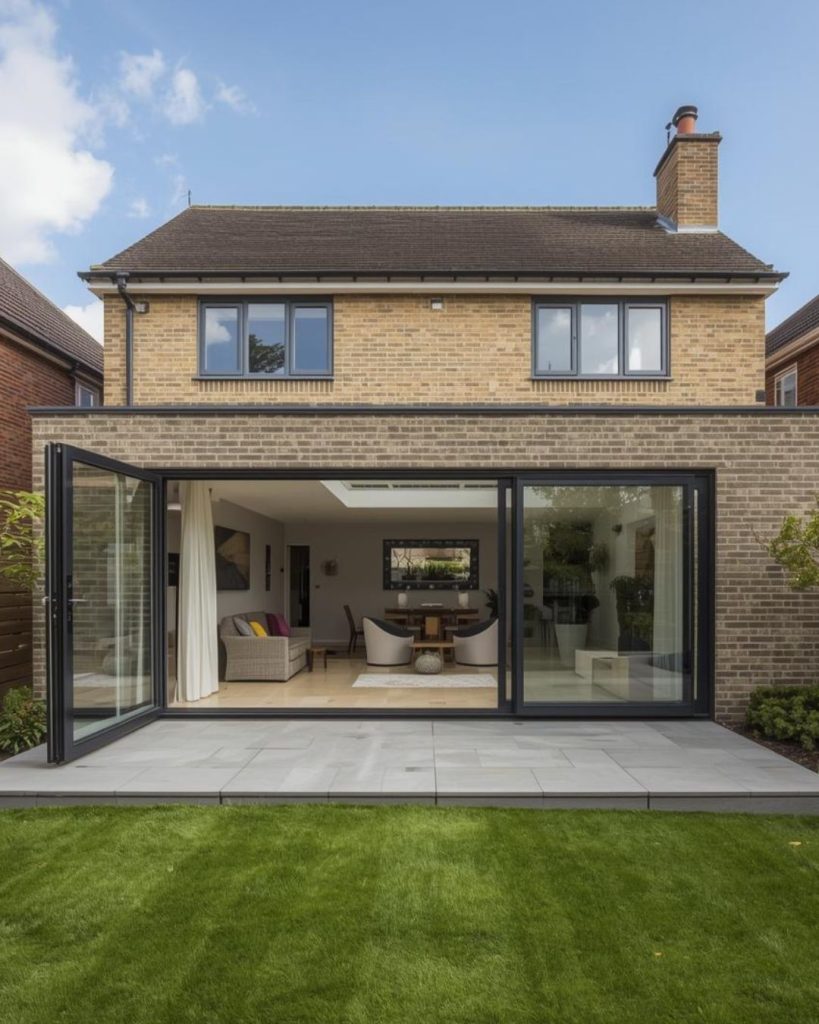
The most common extension type across St Albans’s residential streets — and the one where the cost variation within the type is widest. A simple single storey addition on a level plot with good site access and a lean-to or flat roof at one end of the range. A more complex build on a sloping rear garden, with a premium aluminium bi-fold glazing system, a roof lantern, underfloor heating and a fitted kitchen inside the new space at the other end.
Bi-fold and sliding door systems across the rear elevation are the standard expectation in the St Albans market — the town’s affluent demographic and the consistent demand for high-specification finishes mean that standard French doors are less common here than in many comparable towns. This glazing specification adds meaningfully to the cost. Many single storey rear extensions in St Albans’s residential streets fall within permitted development — though conservation areas and Green Belt designations affect properties in significant parts of the city and surrounding villages.
Double Storey Extension
A double storey addition increases cost significantly but also increases the floor area added by considerably more than a single storey of equivalent footprint. For St Albans’s larger detached properties — particularly in the Marshalswick, Cunningham Hill and Jersey Farm areas — a double storey extension is often the most cost-effective way to add both ground floor living space and an additional bedroom. The additional cost over a single storey of equivalent ground floor area typically runs 40 to 60 percent more — but the usable floor area added is roughly double.
Side Return Extension
Side return extensions suit the Victorian and Edwardian terraces of the St Albans city centre — filling the narrow passage alongside these properties to widen the kitchen and create a more usable ground floor layout. The structural scope is less extensive than a full rear extension, but confined working conditions and almost universal party wall requirements add to the logistical complexity and cost.
Wrap-Around Extension
A wrap-around combines rear and side return into an L-shaped addition that substantially increases the ground floor footprint. For the inter-war and post-war semis of Marshalswick and Cunningham Hill where the original ground floor layout feels restrictive by modern standards, a wrap-around extension combined with an open-plan reconfiguration is one of the most transformative projects we carry out.
What Affects the Final Price?
Specification and Finish
Specification is the most significant single variable in St Albans extension costs — and the one most within the homeowner’s control. The St Albans market consistently favours higher specification finishes than comparable towns further from London. Full-width bi-fold glazing systems, roof lanterns, underfloor heating, bespoke fitted kitchens and premium floor finishes are the norm on mid-to-upper market projects in this area. The structure, foundations and roof of an extension are broadly fixed in cost once the design is agreed — the specification of what goes into and around it can vary the total project cost by 30 to 50 percent.
Planning and Conservation Constraints
St Albans has conservation areas covering significant parts of the historic city, and the Green Belt boundary runs close to several desirable residential areas. The villages of Sandridge, Wheathampstead, Redbourn and Colney Heath sit in or adjacent to Green Belt-designated land where planning constraints on extensions are more stringent than within the city boundary. Extensions that fall within permitted development in most of Hertfordshire may require a full planning application in these sensitive areas — adding professional fees, drawing costs and a two to four month determination period. Pre-application advice from St Albans City and District Council is worthwhile on any sensitive site.
Ground Conditions
St Albans is built predominantly on chalk — which generally provides good, stable foundation conditions. However, clay soils are found in parts of the district and tree root zones are a particular consideration on the larger plots of established residential areas where mature trees are common. Foundation design needs to account for tree root influence where relevant — sometimes requiring deeper foundations or engineered solutions that add cost.
Party Wall Agreements
For terraced and semi-detached properties — which make up a significant proportion of the city’s housing stock — structural work within three to six metres of a shared boundary requires party wall notice. Budget for party wall surveyor’s fees of £800 to £1,500 if the neighbour requires a formal award.
Site Access
Properties in the tightly packed Victorian streets around the Abbey and the city centre occasionally present access challenges — narrow streets, limited parking for trade vehicles and restricted rear access. A builder who works regularly in St Albans factors access conditions into the quote from the outset.
How Long Does an Extension Take in St Albans?
A guide for the main types, including the pre-build phase:
- Single storey, permitted development: five to seven months total
- Single storey, planning required: seven to ten months total
- Double storey, planning required: nine to thirteen months total
- Wrap-around, planning required: eight to twelve months total
The pre-build phase — design, planning where required, structural engineering and party wall — typically accounts for two to four months of the overall timeline. The on-site build for a standard single storey St Albans extension runs twelve to eighteen weeks depending on size and specification.
If you are planning a house extension in St Albans, Harpenden, Radlett, London Colney, Sandridge or anywhere across the St Albans district, we are happy to come out and discuss your project. Get in touch to arrange a visit.